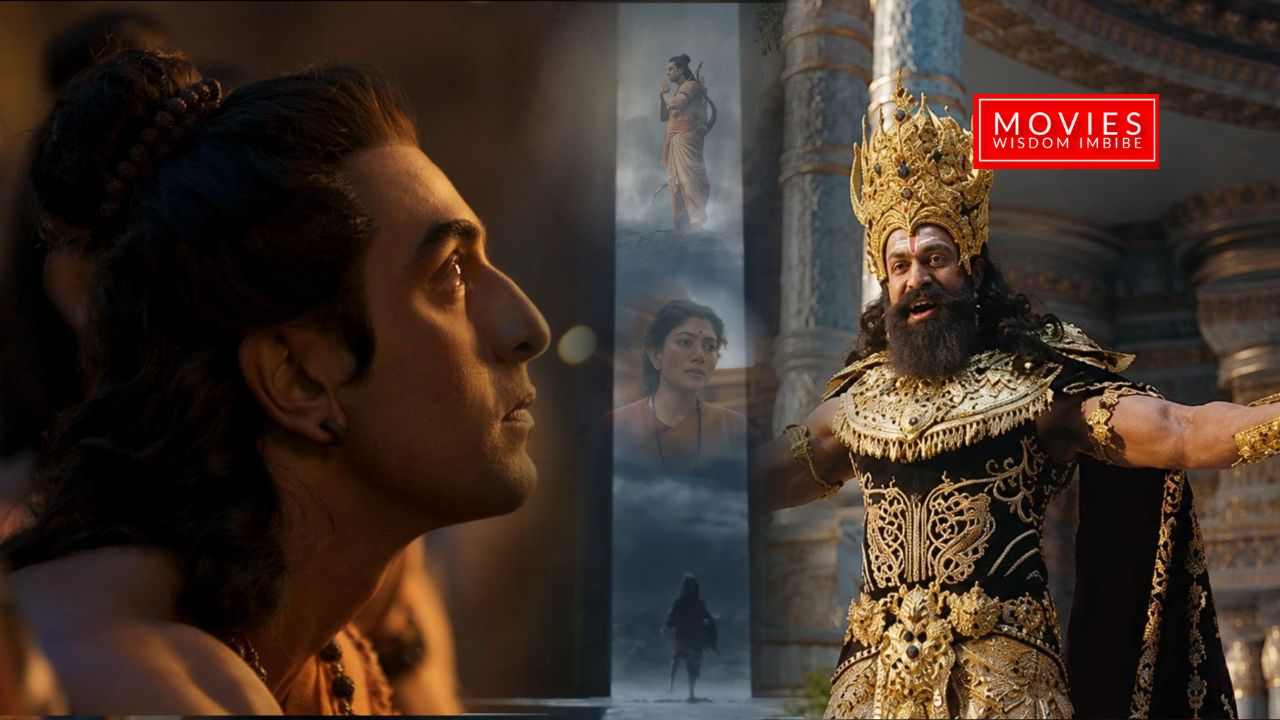
Ramayana Part 1 Trailer: When Ancient Epic Meets Modern Ambition — And Why India Needs to Forget What It Knows
The $500 Million Question: Can Nitesh Tiwari’s Vision Redefine Indian Cinema Forever?
There are trailers that announce movies. And then there are trailers that announce movements. The moment the first footage of Nitesh Tiwari’s Ramayana Part 1 dropped, starring Ranbir Kapoor and Yash, the internet didn’t just react — it erupted.
From YouTube reactors slamming their desks in disbelief to cinephiles analyzing every frame like archaeological evidence, one thing became clear: this isn’t just another mythological retelling. This is a declaration of intent. A statement that says, “We are not here to compete with Indian cinema. We are here to compete with cinema itself.”
The Scale That Demands Attention
Let’s talk numbers, because numbers don’t lie — and this project’s numbers are staggering. A $500 million budget spread across two films. To put that in perspective, that’s not just the most expensive Indian film ever made; that’s entering the rarefied air of Hollywood’s biggest blockbusters.
As one enthusiastic reactor put it, the budget isn’t excessive — it’s essential. The Ramayana isn’t a story you tell in a living room. It’s a saga of cosmic battles, divine interventions, kingdoms rising and falling, and emotions that shake the very pillars of dharma. You cannot capture the unfathomable grandeur of the epic with modest means. You need scale. You need scope. You need the kind of visual ambition that makes audiences forget they’re watching a movie and instead feel like they’re witnessing history unfold.
And the decision to split this into two parts? Absolute genius. Anyone who’s ever sat with the Valmiki Ramayana or even Tulsidas’s Ramcharitmanas knows — this isn’t a three-hour story. Compressing the journey of Rama into a single film would be like trying to fit the ocean into a teacup. The depth, the nuance, the emotional arcs of Rama, Sita, Lakshmana, Hanuman, and yes, even Ravana, demand room to breathe. Two parts isn’t a cash grab. It’s respect for the source material.
The Musical Earthquake: Hans Zimmer Meets A.R. Rahman
If the budget made people sit up, the music collaboration made them fall off their chairs.
Hans Zimmer. The man who gave Inception its heartbeat, Interstellar its soul, and The Dark Knight its operatic darkness.
A.R. Rahman. The Mozart of Madras. The composer who turned Slumdog Millionaire into a global phenomenon and gave Indian cinema its most haunting melodies.
Together? That’s not a score. That’s a sonic event. Reactors across YouTube have been calling this combination “outrageous,” “nasty,” and absolutely unprecedented. And they’re right. This isn’t just about background music — this is about two musical titans from opposite sides of the world converging to create the sound of divinity, war, love, and sacrifice. If the visuals promise to show us the Ramayana, this score promises to make us feel it in our bones.
Visuals That Dare to Dream
Perhaps the most telling reaction came when the creator compared the expected visual quality to James Cameron’s Avatar films. That’s not a comparison made lightly. For years, Indian audiences have winced through sloppy CGI in big-budget spectacles — rubbery creatures, weightless battles, green-screen environments that look like video game cutscenes from 2005.
But Tiwari’s Ramayana seems to be aiming higher. Much higher. The hope is that this project avoids the pitfalls that have plagued other major franchises and instead sets a benchmark so high that future Indian epics will be measured against it. If the trailer is any indication, we’re not just getting a movie — we’re getting a visual revolution.
The Reception: Two Worlds, Two Reactions
Here’s where it gets fascinating.
On YouTube, among international reactors and global cinema enthusiasts, the response has been overwhelmingly positive. There’s a genuine excitement, a hunger to see this story told with the kind of production value it deserves. They want to watch this. They see the trailer and think, “This looks like an event.”
But in India? The reaction is more… complicated.
Yes, there are millions who are thrilled. Who see the trailer and feel goosebumps. Who believe this could be the game-changer that finally makes Indian mythology resonate on a global stage, not just as a regional curiosity but as universal cinema.
But there’s also backlash. Some of it directed at the costumes and dresses — a sensitive subject when you’re dealing with characters who exist in the collective consciousness of a billion people. For Indians, Rama isn’t just a character. Sita isn’t just a role. Hanuman isn’t just a supporting figure. They are family. They are worshipped. They are etched into the spiritual DNA of the nation. So when creative liberties are taken with their appearance, the resistance isn’t just criticism — it’s personal.
And that brings us to the elephant in the room.
Ramayana Part 1 Trailer :
History, Not Mythology: The Weight of Millennia
Here’s something the world needs to understand — and something every Indian feels in their bones: For millions, the Ramayana isn’t mythology. It’s history.
Many outside India may file this story under “myth” or “legend,” but for countless Indians, this is their itihaas — their actual past. The timeline of the Ramayana remains hotly debated among researchers and scholars. Some place it around 5,000 years ago. Others, analyzing astronomical references in the ancient texts, push it further — 7,000 years, 10,000 years, even 12,000 years back. The dates shift depending on the methodology, but the conviction remains unshakable: this isn’t a fantasy cooked up by storytellers. This is the chronicle of real people who walked real lands, whose footprints are still believed to be etched into the geography of the Indian subcontinent.
From the Sarayu river to the forests of Dandakaranya, from the shores of Rameswaram to the distant lands of Lanka — these aren’t just poetic settings. For believers, they are coordinates on a historical map. And when you approach a story with that level of reverence, every creative choice carries the weight of sacrilege or devotion. There is no middle ground.
This is why the costumes matter. This is why the dialogues matter. This is why the look of Rama matters. You aren’t just casting an actor. You are attempting to embody someone who is simultaneously a king, a husband, a son, a warrior, and for millions, a living god.
The Curse of Knowing Too Much
Indians don’t just know the Ramayana. They grew up with it.
Every child in this country knows the story. They know it from Ramanand Sagar’s iconic 1987 television serial, which didn’t just air on Doordarshan — it stopped the nation. Streets emptied. Shops closed. An entire country sat glued to their screens, watching Arun Govil’s serene Rama and Deepika Chikhlia’s ethereal Sita become the definitive visual reference for generations.
They know it from the countless texts — Valmiki’s original, Tulsidas’s devotional retelling, the Kamba Ramayanam, the Adhyatma Ramayana, and hundreds of regional variations. They know it from Amar Chitra Katha comics, from school textbooks, from grandparents’ bedtime stories, from Ramlila performances in every village and town.
The core is always the same: Rama, the ideal man. Sita, the ideal woman. Lakshmana, the ideal brother. Hanuman, the ideal devotee. Ravana, the brilliant villain consumed by ego. But the tellings? Infinite.
And therein lies the challenge — and the opportunity.
A Humble Request to Every Indian: Watch It Like You’ve Never Heard It Before
We know this story by heart. We can recite the dialogues before the actors speak them. We can predict the beats before they arrive. We’ve consumed so many versions that we think we own the copyright to how it should look, sound, and feel.
But here’s the truth: we don’t.
Nitesh Tiwari isn’t making Ramayana for 1987. He’s making it for 2026. For a world where cinema is global, where visual effects can make the impossible real, where a new generation needs to discover why this story has survived for thousands of years — whether you believe that’s 5,000 or 12,000.
So this is a humble request to every Indian viewer: Watch this movie like a fresh story. Forget that you know.
Don’t carry the burden of comparison. Don’t walk in with the mental images from your childhood and measure every frame against them. Don’t ask, “But that’s not how Ramanand Sagar showed it.” Of course it isn’t. It shouldn’t be. That was a masterpiece of its time. This is an attempt to create a masterpiece for ours.
The Ramayana belongs to no single filmmaker, no single generation, no single medium. It is a living, breathing epic that has been retold a thousand times across millennia — through oral tradition, through Sanskrit poetry, through regional folk songs, through television, through animation, and now, through the biggest canvas cinema has ever offered.
If you watch this film waiting to find fault, you will find it. That’s the easy thing to do.
But if you watch it with the openness of someone encountering this story for the very first time — if you let Ranbir Kapoor’s Rama, Yash’s presence, and Tiwari’s vision wash over you without the weight of expectation — you might just experience something rare. You might fall in love with the Ramayana all over again.
The Stakes Couldn’t Be Higher
This isn’t just about one movie. It’s about what Indian cinema can become. If Ramayana Part 1 succeeds — truly succeeds, not just commercially but artistically — it opens a door. It proves that Indian stories, told with Indian sensibilities but global ambition, can stand shoulder-to-shoulder with the biggest spectacles Hollywood has to offer. It proves that our history — our itihaas — isn’t just ours to preserve. It’s the world’s to discover.
The trailer has done its job. It has sparked conversation, controversy, curiosity, and above all, anticipation. The budget is massive. The music is historic. The vision is bold. The reactions are passionate.
Now comes the hard part: living up to the promise.
And when the lights dim and the first frame flickers to life, maybe — just maybe — we should all take a deep breath, leave our preconceptions at the door, and allow ourselves to be surprised by a story we thought we knew by heart.
Because the Ramayana has survived for millennia not by staying the same, but by being retold. Again. And again. And again.
This is just the next telling. And it deserves a chance to be heard with fresh ears.
Ramayana Part 1 is scheduled for release on Diwali 2026 and Part 2 on Diwali 2027. Will it be the game-changer Indian cinema has been waiting for? The trailer suggests it just might be. The rest, as always, is up to the audience.
Recommended for you: